The AI Afterlife: Building Your Digital Persona | Katherine (Kate) Ivanova

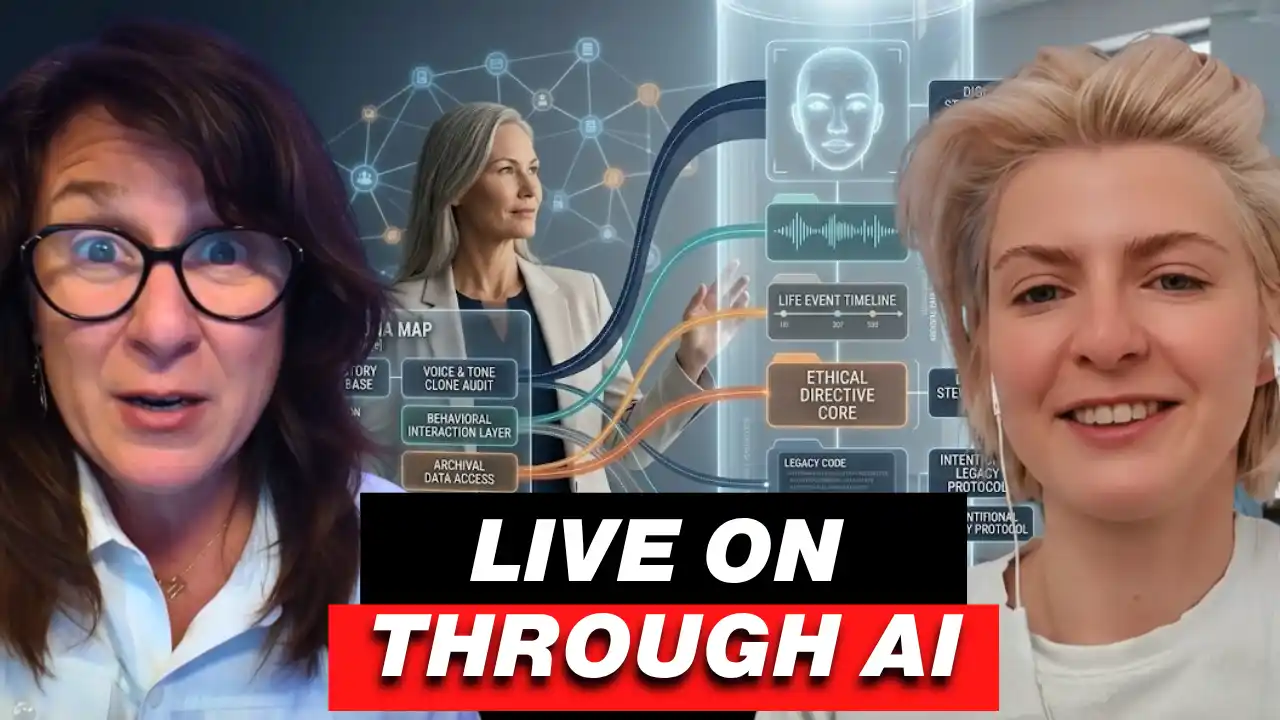
What if you could leave behind an interactive, living biography instead of a static box of memories? Most 27-year-olds are not thinking about end-of-life logistics, but as an immigrant navigating America's highly litigious, documentation-heavy estate system, Kate realized early on that waiting for a crisis is a recipe for overwhelming financial and emotional shock. In this visionary episode of The Digital Legacy Podcast, host Niki Weiss, Digital Thanatologist, sits down with Kate, a team member at Pantio. They unpack a groundbreaking death-tech solution that uses advanced AI, fine-tuned large language models, and voice cloning to capture an individual’s true essence, values, and exact behavioral speech patterns while they are alive. By combining "brain and voice" data, Pantio builds a precise digital persona that allows future generations to maintain an evolving, interactive dialogue with their ancestors long after they are gone.

0:00
0:00
Advertising will end in
play_arrow
pause
replay_10
forward_10
volume_up
volume_down
volume_off
share
speed
Skip ad
close
close
close
close
close

Description:

What if you could leave behind an interactive, living biography instead of a static box of memories?

Most 27-year-olds are not thinking about end-of-life logistics, but as an immigrant navigating America's highly litigious, documentation-heavy estate system, Kate realized early on that waiting for a crisis is a recipe for overwhelming financial and emotional shock.

In this visionary episode of The Digital Legacy Podcast, host Niki Weiss, Digital Thanatologist, sits down with Kate, a team member at Pantio. They unpack a groundbreaking death-tech solution that uses advanced AI, fine-tuned large language models, and voice cloning to capture an individual’s true essence, values, and exact behavioral speech patterns while they are alive. By combining "brain and voice" data, Pantio builds a precise digital persona that allows future generations to maintain an evolving, interactive dialogue with their ancestors long after they are gone.

You’ll discover:

  • The Interactive Biography: How Pantio maps and connects a person's life history, audio recordings, publications, and social media posts into an evolving, precise representation.

  • Beyond ChatGPT: Why standard chatbots fail at long-term legacy due to short chat memory limits, and how proprietary data mapping preserves a lifelong timeline.

  • Behavioral Mirroring: The technical process of cloning not just a voice, but matching specific speech rhythms, vocabulary choices, and natural pauses.

  • Granular Privacy and Consent: How clients retain 100% control over their data, utilizing precise custom contracts to lock away intimate memories for specific family members or establish an account termination date.

  • The Direct-to-Consumer Pivot: Why death-tech platforms find direct-to-consumer pipelines challenging, opting instead to embed legacy technology into B2B legal and educational partnerships.

  • "Planning Your Party Without You": How creating an AI persona behaves as a smooth entry point that breaks down taboos and gently guides families to face their legal wills and final disposition choices.

Because as Kate beautifully notes, "It is in our human nature to want to leave a legacy behind—and we consistently underestimate how profoundly we can lighten up the days of the people we leave behind."

Related Podcast

How the Medical System Bankrupts Families in the Last 3 Years of Life | William Donaldson

What happens when a NASA engineer and pilot applies the logic of a flight plan to the most inevitable journey of all? In this profoundly liberating episode of The Digital Legacy Podcast, host Niki Weiss, Digital Thanatologist, sits down with Willy Donaldson, a finance professor, engineer, and author of Estimated Time of Departure. Willy shares the "love story" of how he turned the terrifying taboo of death into a series of cathartic and even humorous conversations with his parents, ensuring their final departure was handled with the same rigor as a pilot filing a flight plan. You’ll discover: Why you should treat your end-of-life departure with the same logistical detail as a flight route—telling your family exactly when you're "leaving" and how many bags you're taking. Introducing "Allow a Natural Death" (A-N-D)—a more humane, personal constitution that focuses on biographical wishes rather than just medical ones. The Three C's: Ancient tribal wisdom on when a human journey is truly complete: Communication, Contribution, and Commuting. The staggering reality that nearly 20% of Medicare funds are spent in the final weeks of life on interventions that extend duration but destroy quality. Why a 150-year-old body held together by artificial implants might not be the future you actually want. A powerful conversational hack for resistant parents—stop asking what they want and start documenting what they refuse to endure. Because as Willy notes, "Death only really occurs when the last person on earth mentions your name."

Listen Now
The Tech That's Revolutionizing the Death Space | Virtual Autopsy PT 1 | Ash Govind

What happens when the ancient practice of the scalpel meets the future of digital imaging? In this part 1 of exploring Virtual Autopsy in the The Digital Legacy Podcast, host Niki Weiss, Digital Thanatologist, sits down with Ash Govind from Virtual Autopsy UK. They discuss how they are "turbocharging" 30-year-old radiological technology to replace the knife with a CT scanner, providing a dignified, non-invasive alternative for families and faith groups worldwide. You’ll discover: How virtual autopsy uses CT data to "Xerox the deceased," allowing radiologists to analyze every 1mm slice of the remains without a single incision. Why this technology is a vital "must-have" for Jewish and Muslim faith groups, whose religious laws require speedy burials and prohibit the interference of remains. How avoiding traditional "Y" and "I" incisions prevents the emotional trauma and scars families face when viewing a loved one at a funeral. Why digital post-mortem data is superior to physical evidence, as it can be transported to world experts for review long after the body has been laid to rest. In 93% of cases, a virtual autopsy is enough to conclude the probable cause of death without any invasive intervention. How virtual autopsies are revolutionizing the investigation of service members killed in conflict, providing a list of injuries while honoring the dignity of those who fought for their country. Because as Ash Govind says, "Dignity and respect in death is important—this is not just a scientific benefit, it is a humanitarian mission."

Listen Now

Comments